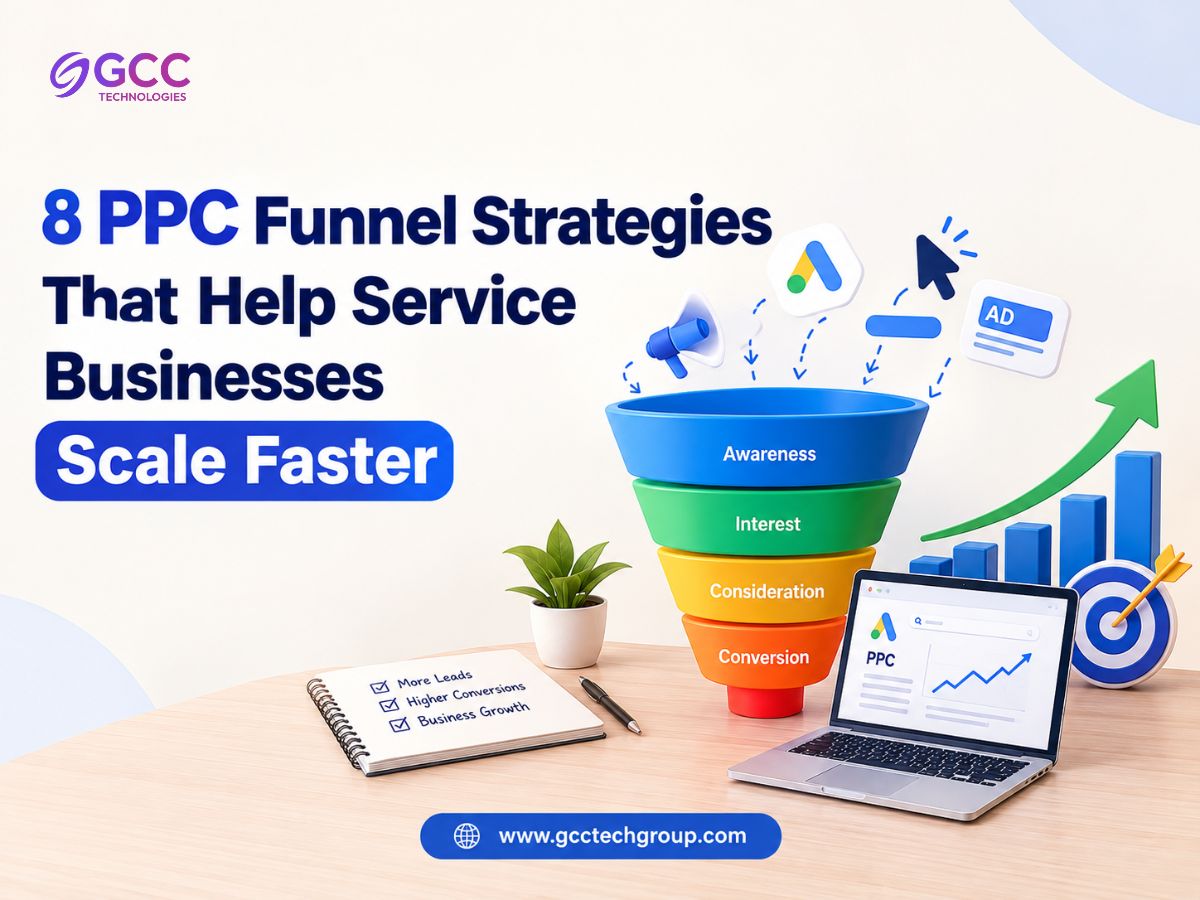
PPC funnel strategies match every ad, landing page, and follow-up message to where a buyer is in their decision. For a service business, that means capturing people who are ready to hire, warming up people who are still comparing, and bringing back people who left without enquiring. The eight strategies below show you how to do this step by step, so more of your clicks turn into qualified leads and fewer are wasted.
How to Build a PPC Funnel for Service Businesses
A PPC funnel is the path someone takes from seeing your ad to becoming a paying client. Instead of sending every click to one generic page, you create separate steps for people at different levels of readiness.
Most service funnels have three stages:
- Awareness: The person has a problem but has not picked a provider.
- Consideration: The person is comparing providers, reading reviews, and checking prices.
- Decision: The person is ready to call, book, or request a quote.
Service buyers behave differently from online shoppers. They cannot try your service before they buy it, so trust carries more weight than a product photo. They usually compare a few providers and make contact only when they feel confident. That is why PPC advertising for service businesses needs proof, clear next steps, and easy ways to get in touch built into every stage.
Many paid advertising strategies fail for one simple reason. They treat every click as if it came from the same type of person. A funnel fixes that by giving each type of visitor the right message at the right time.
1. Start With High-Intent Searches
Begin where buyers are closest to hiring. These are people who type a service together with a location, or add words like “near me”, “quote”, or “book”. Google Ads lead generation works best here because the person is already looking for help. You are answering a need, not interrupting someone.
What to do:
- Build tightly themed ad groups around one service each
- Use phrase and exact match for your core terms
- Add location terms and set precise location targeting
- Write ads that name the service, the area, and one clear reason to choose you
This stage also gives you the fastest feedback. Within a few weeks you will see which services and messages bring real enquiries. If you would like experienced hands on this stage, professional Google Ads management can speed up the learning and reduce early waste.
2. Separate Campaigns by Funnel Stage
Mixing “what is the cost of a roof repair” with “emergency roof repair near me” in one campaign is a common mistake. These searches come from people with very different intent, so they need different ads, bids, and goals.
A simple structure looks like this:
- Bottom of the funnel: Service and location keywords, aimed at calls and form fills
- Middle of the funnel: Comparison and “best” keywords, aimed at consultations and downloads
- Top of the funnel: Problem-based and question keywords, aimed at building awareness
Keeping them separate lets you give each stage its own budget and measure it fairly. A top-of-funnel campaign will never match the direct lead volume of a bottom-of-funnel one, and that is fine. Its job is to feed the stages below it. Judge it by the quality of the audience it builds, not by immediate sales.
3. Invest in Landing Page Optimization
A strong ad can only do half the job. The landing page decides whether the click becomes a lead. Landing page optimization is often the quickest way to get more from the same traffic.
Focus on these basics:
- Message match: The headline should echo the ad the visitor just clicked
- One goal per page: Remove extra menus and links that pull attention away
- Visible proof: Add reviews, client logos, certifications, and short case results
- Easy contact: Place a click-to-call button and a short form above the fold
- Fast mobile experience: Most service searches happen on phones, so test on one
A good test is the five-second check. Show your page to someone unfamiliar with your business and ask what you offer and what they should do next. If they hesitate, your visitors will too.
4. Offer a Low-Pressure Next Step
Not everyone is ready to book on the first visit. If your only call to action is “Request a quote”, you lose people in the middle of the funnel who still need reassurance.
Give them a smaller step that still captures their details:
- A free consultation or discovery call
- A short audit or assessment of their current situation
- A checklist or guide that solves one specific problem
- A simple estimate tool for common requests
These offers lower the risk for the visitor and give you permission to follow up. They also create a warmer lead than a cold form fill, because the person has already received something useful from you. Make sure the offer fits the stage. A guide suits someone researching, while a free consultation suits someone nearly ready to decide.
5. Use Retargeting Campaigns to Win Back Visitors
Most visitors will not enquire on the first visit, and that is normal. Retargeting campaigns show relevant ads to people who already visited your site, so you stay in their mind while they decide.
Smart ways to set them up:
- Group audiences by behavior, such as pricing page visitors, form starters, and blog readers
- Show proof first, such as reviews and results, then follow with an offer
- Use a frequency cap so people are not shown the same ad too often
- Exclude people who have already converted
The message should change with the audience. Someone who reads a guide needs a gentle nudge toward a consultation. Someone who abandoned your form needs a reminder and a reason to finish. Retargeting is often one of the most efficient parts of the funnel because the audience already knows you.
6. Protect Lead Quality While Lowering Costs
More leads do not always mean more clients. If your phone rings with people who cannot afford you or live outside your area, your cost per lead looks good on paper while your sales team loses time. Real cost per lead optimization means lowering the cost of leads that actually become clients, not just lead volume.
Practical ways to improve quality:
- Add negative keywords weekly to block irrelevant searches
- Include qualifying questions in your forms, such as service type and timeline
- State your service area and who you work with on the page
- Track phone calls so you can tell which ads bring serious callers
- Import completed sales back into your ad account so it learns what a good lead looks like
When the ad platform learns from real outcomes instead of just form fills, it finds better prospects over time. This single change can shift an account from chasing cheap leads to attracting valuable ones.
7. Speed Up Your Follow-Up
Many businesses spend heavily to generate a lead and then take a day to respond. By then, the prospect has often spoken to someone else. Sales funnel optimization does not end at the click. It continues until the conversation starts.
Build a simple response system:
- Send an instant confirmation by email or message after every enquiry
- Assign each lead to a named person right away
- Call new leads as quickly as you can, ideally within minutes
- Create a short follow-up sequence for people who do not answer
- Record the outcome of each lead in a CRM
If you notice many leads but few clients, look here before blaming the ads. The problem is often response speed, not traffic quality. Our guide on why hiring a Google Ads agency in Dubai can pay off also covers how agencies connect ad data with lead handling, which helps if your team is stretched.
8. Measure Revenue and Keep Testing
The last strategy ties the others together. PPC conversion optimization only works when you measure the right things. Clicks and impressions show activity, but revenue shows progress.
Track these at every stage:
- Calls, form submissions, and booked appointments
- The share of leads that become qualified opportunities
- The share of opportunities that become clients
- Which campaigns and keywords produced those clients
Then test one change at a time. Try a new headline, a shorter form, a different offer, or a new call to action. If you change five things at once, you will not know what worked. Review your search terms report each week, pause what drains budget, and put more behind what produces clients. Small, steady improvements compound faster than big, occasional overhauls.
The 8 Strategies Compared
Use this table to see where each strategy fits and what to measure.
| Strategy | Funnel Stage | Main Goal | Key Metric to Watch |
| High-intent search campaigns | Decision | Capture ready-to-hire buyers | Conversion rate |
| Stage-based campaign structure | All stages | Match budget to intent | Cost per qualified lead |
| Landing page optimization | Decision | Turn clicks into enquiries | Landing page conversion rate |
| Low-pressure next step | Consideration | Capture hesitant prospects | Offer sign-up rate |
| Retargeting campaigns | Consideration and decision | Win back visitors | Return visit conversion rate |
| Lead quality filtering | Decision | Attract serious buyers | Lead-to-client rate |
| Fast follow-up system | After the lead | Start conversations sooner | Response time and contact rate |
| Revenue tracking and testing | All stages | Improve results over time | Revenue per campaign |
How to Scale a Service Business With Google Ads
Once your funnel produces steady, good-quality leads, you can grow it. The order matters, because scaling a weak funnel only multiplies the waste.
Follow this sequence:
- Lock in what works. Identify the campaigns that bring clients, not just leads.
- Increase budgets gradually. Raise spend on proven campaigns in small steps and watch quality.
- Expand one thing at a time. Add a new service or a new location, then measure before adding another.
- Strengthen the upper funnel. Add video or display campaigns to feed your retargeting audiences.
- Review weekly. Catch drops in quality early, before they become expensive.
Strong PPC lead generation is less about spending more and more about repeating what already works. If you want a partner to handle this, our lead generation services focus on exactly this kind of steady, measurable growth.
For businesses in the UAE, GCC Technologies builds these funnels around local search habits, language preferences, and fast-moving competition. Our PPC Service in Dubai covers everything from campaign structure to landing pages and reporting, so each stage supports the next.
Common Mistakes That Drain Your Funnel
Before you apply the strategies above, check that you are not making these errors:
- Sending all traffic to the home page instead of a focused landing page
- Judging every campaign by the same goal
- Ignoring phone calls when tracking results
- Leaving converted visitors in retargeting audiences
- Changing too many things at once, so you cannot learn from tests
- Reporting on clicks instead of clients
Fixing even two or three of these often improves results without adding any budget.
Frequently Asked Questions About PPC Service
1. What are PPC funnel strategies?
PPC funnel strategies are methods for guiding people through the buying journey using paid ads. Each stage has its own keywords, ad messages, landing pages, and follow-up, so visitors get the right content for how ready they are to buy.
2. What are the best PPC funnel strategies to generate qualified leads?
The most effective ones are targeting high-intent searches, building message-matched landing pages, using retargeting, filtering for lead quality, and following up quickly. Combined, they attract the right people and make it easy for them to contact you.
3. How can I improve PPC conversion rates for service businesses?
Start with the landing page. Match the headline to the ad, show reviews, shorten the form, and add a click-to-call option. Then test one change at a time and track calls as well as form fills, because many service customers prefer to phone.
4. How do I reduce cost per lead with PPC advertising?
Block irrelevant searches with negative keywords, improve your ad relevance, and raise landing page conversion rates. Also feed real sales data back into your ad account so it targets people who actually become clients, not just those who fill in forms.
5. How long does it take to see results from a PPC funnel?
Early signals such as click quality and enquiry volume usually appear within the first few weeks. Reliable patterns on lead quality and cost take longer, since the account needs time to learn and you need time to test and refine.
6. Which funnel stage should I invest in first?
Start at the bottom, with high-intent searches. These bring the fastest enquiries and the clearest data. Once that stage performs well, add consideration campaigns and retargeting to capture the people who are not ready yet.
Conclusion
A good PPC funnel does not rely on luck or bigger budgets. It relies on understanding where your buyers are, speaking to them at that moment, and making the next step easy. Start with high-intent searches, build focused pages, bring visitors back with retargeting, protect lead quality, respond quickly, and measure what matters. Do these consistently and your service business will grow on a stronger, more predictable foundation.
Ready to turn your ad clicks into real clients? Talk to GCC Technologies about a funnel built around your services, your market, and your goals. Explore our full Digital Marketing Service in Dubai offering or contact our team today to get started.